After a brief hiatus in Georgia to pick up the new car (aka "the Millenium Falcon"), ...and Enide is back...
Over the past few days, Adam and I have found ourselves re-exploring Dante's Divina Comedia. Both of us read The Inferno in high school, but neither of us has ever explored the rest of the three-part poem in depth. I'm only now realizing how deprived I've been.
In The Inferno, Dante finds himself alone in a dark wood. Virgil (of Aneid fame) finds the frightened Dante and proposes that they both undertake a most surprising journey--through hell, past purgatory, into heaven. Virgil guides him through the nine circles of hell, protecting him from demons and monsters, until they escape hell and begin to climb the mountain of purgatory. Again, Virgil prove himself a loving and powerful guide through purgatory. At the gates of heaven, the pagan Virgil leaves Dante in the care of Dante's beloved Beatrice.
The first time I read the poem, I focused on Virgil. Virgil is Dante's guide in his imaginative realms of hell and purgatory, as well as a literary guide for the writing of the poem itself. I've only gradually realized that to pay attention only to Virgil--even in The Inferno and Purgatorio--is to completely miss the point. Beatrice is Dante's guide in the poem, and in his life, whether she is present or not.
In my own defense, I think I lacked the context to understand Beatrice's role when I read the poem as a Protestant. She's Dante's intercessor, the one who brings his cause before heaven. It's a role saints like Beatrice can only play when we accept the communion of all believers, living and dead. Even in the darkest pits of hell, Beatrice sends Dante help and hope.
But Beatrice is far more than intercessor. She's an active guide in Paradiso, but also in The Inferno and Purgatorio, as well as in the whole of Dante's life. Her name itself--meaning "bringer of gladness"--takes on an allegorical meaning. She is the person in which Dante sees God. She's no false idol for Dante, but a presence that makes him feel irradiated with God's love. Dante sees God in Beatrice. Thinking about her, writing about her, striving to reach the heaven in which she resides--all these things draw Dante closer to God. Her role as guide through heaven is the perfect allegorical fulfillment of her role in Dante's life.
That's a role I never understood until I fell in love. Adam is my "Beatrico." In his love, I feel God's love for me shining through. Adam's goodness and compassion give me a model for behavior, but by themselves draw me closer to God. He's not just my fiance and won't just be my husband. He's also a walking allegory, a representation of what God's love looks like and feels like. That's why I feel so strongly called to the vocation of marriage--the love of the man I hope to call my spouse draws me further up in and further in to God's love every day.
Showing posts with label literature. Show all posts
Showing posts with label literature. Show all posts
Tuesday, July 7, 2009


Tuesday, June 30, 2009
The Scarlet Pimpernel and Marriage
One of the fondest memories of former Brookewood seventh-graders seems to be reading Baroness Orczy's The Scarlet Pimpernel. Never one to willingly disappoint, I duly picked up the novel to read over the summer so I could read it with my new students when the school year starts. So, when my maid of honor forced me to watch The Scarlet Pimpernel on DVD, I was shocked and appalled by the shear banality of the story.
The film tells the story of an outrageous fop who secretly helps rescue French nobility from the jaws of the guillotine in the year of grace 1792. His wife, unaware of his alter-ego, unwittingly aids her ex-lover, now-French-special-agent in the discovery of her husband. The story follows the trite pattern of a super-hero movie where the beautiful, hapless heroine discovers the secret identity of her noble lover. There is, of course, a daring series of intrigues leading up to a predictable climax. Not literature.
But the film fundamentally misunderstands the novel. The novel isn't about the Scarlet Pimpernel, or Sir Percival Blakely, at all. It's about his wife, Lady Marguerite Blakely, and the couple's discovery what marriage really is.
In the novel, the audience sees inside the mind of Lady Blakely. She, too, has been taken in by the foppish facade of her aristocratic husband. She married him because he stood out as the most devoted among countless admirers. He has ceased to love her. She cannot understand why and holds him in contempt for his unintelligence.
She is so selfishly caught up in her own world that when the French agent presents her with a terrifying choice--whether to save her brother from the guillotine at the price of helping to identify the Scarlet Pimernel--she never seriously considers going to her husband for aid. She has too little respect for him as a person and a man to trust him. Only later, the dirty deed irrevocably done, does she think to speak with him about what has happened.
When she starts to speak with him, the audience finally finds out what motivates them both--what estranges them and ruins their marriage. Pride. The night they were married, Sir Percival discovered that his wife had sent someone to the guillotine. Trusting in his undying devotion, Lady Blakley proudly refused him an explanation. Out of pride, Sir Percival hid all his affection from her, unwilling for the world to see his love for the heartless women he then believed his wife to be. Out of pride, Lady Blakely refused to tell him how unwitting her betrayal had been. For a year, they hadn't shown each other the mutual affection they smolders beneath the surface of their cold relationship or to tell each other the truths the long to reveal.
The rest of the novel chronicles Lady Blakely's gradual realization who her husband is and the terrible betrayal she has made out of ignorance. To save him, she tracks him to Dover and then across the channel to France. In an inversion of the story of Erec and Enide, she slowly realises that her doddering fool is the bravest and most competent man in Europe. She regrets that she has been so blinded by pride that she could not detect his identity sooner and spare the betrayal. When they are safe, Sir Percival in turn laments the pain and suffering his proud reticence caused his wife.
The filmed versions of The Scarlet Pimpernel make into an adventure story what is actually a beautiful love story. The novel's brilliance lies in Lady Blakely's slow discovery how strong and masculine her husband is. It lies in Sir Percival's hard-won realization how important honesty is in a relationship. And it lies in the couple's final understanding that pride has no place in a happy, open marriage.
Wednesday, June 10, 2009
The Problem of Modern Novels: Howards End and Marriage
If you've ever asked me if I've read a novel, you've probably gotten my token response: "Is the author still alive?" I just don't read modern literature. The snooty Medievalist comes out and wonders, "If it hasn't already withstood the test of time, how do I know it's worth my time to read it?" Besides, modern novels tend to be bleak, depressing with no uplifting moral at the end. They all seem to be about unstoppable decay or the loss of meaning. I don't want to read about those things. How are they going to make me happier or better?
I picked up a copy of E. M. Forster's Howards End from the Chaplaincy library in a moment of desperation for something to read. Being a modern novel, events were sure to disappoint the idealistic heroines who "desired that public life should mirror whatever is good in life within." When Margaret, the earnest protagonist marries the emotionally stunted capitalist, Mr. Wilcox, the reader can almost be ensured of tragedy. Her plan to love him--because "the more she let herself love him, the more chance was there that he would set his soul in order"--is surely set up to fail.
Imagine my surprise and delight to discover that Howards End is nothing I fear in modern novels. Instead of gradually leading readers into disillusionment with Margaret, the narrator helps us to slowly develop a respect for her quiet strenghth. Instead of agnostically challenging the value of love in a modern, transient world, Forster focuses our attention on the ever-increasing importance of marriage and stability. The titular home, Howards End, isn't symbolic for loss of place, as I originally expected. Instead, it's the place where the protagonists "stop," finally finding rest and peace in their love for each other.
In the end, against all odds--and against all of my expectations for a modern novel--Margaret's love really does redeem her husband. Her sisters describes it best: "You picked up the pieces and made us a home. Can't it strike you--even for a moment--that your life has been heroic?" There is something indomitably heroic about Margaret's life. Loving without counting the cost, with perfect faith in the goodness she sees within people if only someone has the patience and courage to draw it out. Nothing turns out for Margaret the way she plans. But, in her unwaivering support for her husband and her family, she makes a happy life for herself.
Adam says I don't like happy stories, but I think he misunderstands. I like stories with substance and meaning--those just often turn out to be the sad ones. I don't like most modern novels, but I do like Howards End. If Margaret's hopes were frustrated, if Forster affirmed the futility of human relationships, it would be a far less true book than it is the way it stands. Margaret has a happy ending, even though its nothing like she expected. And its because she had the courage to love.
I picked up a copy of E. M. Forster's Howards End from the Chaplaincy library in a moment of desperation for something to read. Being a modern novel, events were sure to disappoint the idealistic heroines who "desired that public life should mirror whatever is good in life within." When Margaret, the earnest protagonist marries the emotionally stunted capitalist, Mr. Wilcox, the reader can almost be ensured of tragedy. Her plan to love him--because "the more she let herself love him, the more chance was there that he would set his soul in order"--is surely set up to fail.
Imagine my surprise and delight to discover that Howards End is nothing I fear in modern novels. Instead of gradually leading readers into disillusionment with Margaret, the narrator helps us to slowly develop a respect for her quiet strenghth. Instead of agnostically challenging the value of love in a modern, transient world, Forster focuses our attention on the ever-increasing importance of marriage and stability. The titular home, Howards End, isn't symbolic for loss of place, as I originally expected. Instead, it's the place where the protagonists "stop," finally finding rest and peace in their love for each other.
In the end, against all odds--and against all of my expectations for a modern novel--Margaret's love really does redeem her husband. Her sisters describes it best: "You picked up the pieces and made us a home. Can't it strike you--even for a moment--that your life has been heroic?" There is something indomitably heroic about Margaret's life. Loving without counting the cost, with perfect faith in the goodness she sees within people if only someone has the patience and courage to draw it out. Nothing turns out for Margaret the way she plans. But, in her unwaivering support for her husband and her family, she makes a happy life for herself.
Adam says I don't like happy stories, but I think he misunderstands. I like stories with substance and meaning--those just often turn out to be the sad ones. I don't like most modern novels, but I do like Howards End. If Margaret's hopes were frustrated, if Forster affirmed the futility of human relationships, it would be a far less true book than it is the way it stands. Margaret has a happy ending, even though its nothing like she expected. And its because she had the courage to love.
Sunday, May 31, 2009
Hard Times and Marriage
 More than a year ago, I dispatched Adam to read my very favorite Dickens novel, Hard Times. After struggling a bit through the beginning of the novel--Adam doesn't share my a priori love of depressing or straight-forward literature--he returned with a surprising verdict: Hard Times is a wonderful novel about marriage.
His announcement really shocked me. I'd like to consider myself an astute literary critic, but I'd completely missed any significant emphasis on marriage. Sure, the action largely centers around two couples, but surely the novel is about the monetary poverty and suffering of the lower classes, and the mental poverty and suffering of the elite. Armed with Adam's assessment, I returned to the novel over the last couple of weeks. Though I'll stick to my Dickensonian guns about themes of poverty, I think Adam was also right.
"Now, what I want is, Facts. Teach these boys and girls nothing but Facts. Facts alone are wanted in life...This is the principle on which I bring up my own children, and this is the principle on which I bring up these [school]children." These words open the novel and introduce the character of Louisa Gradgrind, the daughter of the speaker and the female partner in one of the two major relationships in the novel.
From a very early age, Lousia's father encourages her to dismiss her emotions and her fancies. She completely lacks experience in love and accepts an offer that would make her father and her brother happy--she marries the much senior Mr. Boundaby, the greatest humbug in the town. Needless to say, their marriage is unsuccessful.
Their loveless marriage contrasts sharply with the tragic love affair between Stephen and Rachel. Stephen, too, is trapped in a dreadful marriage with a woman who became an alcoholic and left him. He finds a long-term helpmate in Rachel, who tends to him with a quiet devotion, knowing that Stephen will never be able to marry her--no matter how much he wants to. Dickens draws our attention to how love makes a sacramental bond far more powerful than an unfeeling ceremony. Stephen gets from Rachel what only a blessed man finds in his wife: "I nevermore will see or think o' anything that angers me, but thou, so much better than me, shalt be by th' side on't." He looks forward to the day the two will be together in the bliss of eternity.
The greatest tragedy of the novel is not this poor couple's--they have hope for the future, even if it is only after death. Louisa has no hope. Her life is meaningless, and she knows it. Her upbringing has ruined her for the vocation to marriage for which her indomitable compassion suggest she is intended. Her father ironically admits this when he discusses Boundaby's proposal with her--"You do not come to the consideration of that question with the previous habits of mind, and habits of life, that belong to many young women." The goodness within her gradually stirs, first as she strives to help Rachel and then as she falls under the influence of her foster-sister, Sissy. But even after she returns to her father's house and her husband dies, she is permanently scarred. All the time in the world left to her "better nature" cannot undo what has been done. She remakes herself as a women children love, but is never loved by a man again.
What does all of this say about marriage?
First of all, love is what makes a marriage. Stephen and Rachel may never consummate their "marriage," but they are bound in a way far deeper than Lousia and Boundaby could ever be. A marriage without love means nothing.
Second, and more importantly, God grants to each of us only one life to live. Poor Louisa's life, the vocation her loving and compassionate nature could have meant for her, were stolen by bad habituation very early in life. To love, to be capable of receiving love, requires a lifetime of continually developing good habits. There is very little in life sadder than an unrealized vocation.
Monday, May 25, 2009
Literary Happiness
Leo Tolstoy wrote that "Happy families are all alike; every unhappy family is unhappy in its own way." The line is one of the most famous in Western literature. It seeps into the reader's soul with a kind of all-pervading "true-ness." But is he right?
Adam has been making fun of me recently for my choice in literature. I like depressing books where unhappy things happen to characters. I think the only poetry really worth reading is poetry about dejection, loss, and pain. These stories and poems seem to mean something in a way other stories don't. If Tolstoy is correct--unhappiness is a unique, case-by-case, individual experience--how can it be that the literary texts, the ones that are supposed to capture universal human experience, are so often the tragic ones?
There are many poems that describe the way I feel when Adam is far away. Many that capture the fears I have about losing him. But there are no poems that express the way I love him. No poems that encapsulate the way he makes me feel. There are analogies in texts, and I've written about these, but nothing really fits us. It isn't our unhappiness--missing each other like we'd miss a piece of ourselves--that makes us unique. Lots of people spend months, years, or even decades apart from their lovers. It's our love, our own story of our vocation to marriage, that makes us unique. Our unhappiness is shared; we are happy in our own way.
So perhaps that's why I prefer "depressing" poetry to "happy" poetry, if such simplistic labels ought to be applied. Sadness is sublime. It transcends human differences of time, or class, or race so that I enter into Poe's pain, Longfellow's longing, and Hardy's obstinate grip on hope. Happiness is transcendental. My love, my happiness, is intimate, uniquely shared with only one other person. It's our own. We can, and hope, to pass it on to others. But I can only ever share my happiness with Adam.
Am I wrong? I'd love to learn about the positive stories, songs, or poems that you find compelling.
Adam has been making fun of me recently for my choice in literature. I like depressing books where unhappy things happen to characters. I think the only poetry really worth reading is poetry about dejection, loss, and pain. These stories and poems seem to mean something in a way other stories don't. If Tolstoy is correct--unhappiness is a unique, case-by-case, individual experience--how can it be that the literary texts, the ones that are supposed to capture universal human experience, are so often the tragic ones?
There are many poems that describe the way I feel when Adam is far away. Many that capture the fears I have about losing him. But there are no poems that express the way I love him. No poems that encapsulate the way he makes me feel. There are analogies in texts, and I've written about these, but nothing really fits us. It isn't our unhappiness--missing each other like we'd miss a piece of ourselves--that makes us unique. Lots of people spend months, years, or even decades apart from their lovers. It's our love, our own story of our vocation to marriage, that makes us unique. Our unhappiness is shared; we are happy in our own way.
So perhaps that's why I prefer "depressing" poetry to "happy" poetry, if such simplistic labels ought to be applied. Sadness is sublime. It transcends human differences of time, or class, or race so that I enter into Poe's pain, Longfellow's longing, and Hardy's obstinate grip on hope. Happiness is transcendental. My love, my happiness, is intimate, uniquely shared with only one other person. It's our own. We can, and hope, to pass it on to others. But I can only ever share my happiness with Adam.
Am I wrong? I'd love to learn about the positive stories, songs, or poems that you find compelling.
Sunday, May 17, 2009
Another Medieval Marriage

Much of the work on my dissertation focuses on the romance Guy of Warwick. The work has provided me with yet another medieval model of marriage, but this time with a few more added questions.
As a young man, Guy falls in love with the king's daughter, Felice. He goes to her and tells her that he loves her, but she rebuffs him. She's a princess, he a mere retainer's son. When he seeks her attentions again, she tells him that she will accept his love only if he becomes the greatest knight in the world.
Guy spends the next seven years traveling in Continental Europe and the Middle East winning tournaments and defending good against evil. He finally returns as the most renowned and talented knight in the world. He marries Felice, the most beautiful and intelligent woman in the world. They are the perfect couple.
Up to this point, the romance perfectly captures my ideal for marriage. Guy's love for Felice forces him to be better, striving to earn her love. It isn't just that he's showing off. He can't just appear to be the best knight, but must become the best knight--with all the qualities of courtliness, moral strength, and chivalry that go with the title.
A subtle allegorical note makes the romance even more astute. Felice's name means "happiness." Medieval philosophers recognized happiness as the greatest good of human life. She's not only the perfect woman, but the greatest good which Guy can ever attain in this life. Who wouldn't love that image of marriage? Guy's marriage to Felice represents a man who has worked hard to become perfectly happy.
But that happiness isn't enough for the romance writer, or for Guy. Just two weeks after they marry, Guy walks alone along the parapet of his castle, staring at the stars. He suddenly realizes what a fool he has been, working all his life for the sake of Felice rather than for the sake of Christ. So he leaves Felice, simply packs up and walks out on a pilgrimage which will consume the rest of his life. He's gone to seek God--Felice and earthly happiness are left by the wayside.
Felice, left sobbing on her own in her husband's extended absence, struggling to do good on her own: the most terrifying image of marriage I can imagine. She's been tossed aside by a husband who goes to seek a greater good. Their marriage has been insufficient. It hasn't brought Guy any closer to God. What a nightmare!
So the romance left me wondering: how realistic is it to expect marriage to help me be better? Why are there so few married saints? Is it really that hard to be married and holy, so hard that Guy had to leave Felice?
Adam and I want to commit ourselves to a life of doing good and seeking God together. I can't imagine the pain it would cause both of us if either struck out on his own her own. We hope our felicity will lie in our marriage to each other and, in loving each other, we can grow closer to God.
Friday, April 3, 2009
A Love for All Ages
I try very hard to admit when I'm wrong. I was wrong to condemn Twilight outright. I'll stick to my guns about how wildly inappropriate it is for the reader of its usual demographic, but, for me, the four-novel saga has been eye-opening.
Traditionally, good literature doesn't tell the reader anything more than it has to. It shows the reader. We all recognize that the best kinds of learning come from experience, so it only makes sense that the structure of a narrative does more for the reader than narration itself does. So often, novels that tell the reader outright what the characters are thinking and what their actions mean are just poorly written.
Just imagine, though, a novel writer who completely absorbs the reader in one character's mind. Every minute detail of every perception presented to for the reader's consideration. Every nuance of every decision spelled out for the reader to process. And every sensation of every sense cataloged for the reader to experience. It's a different kind of reading. Not learning by watching, which works so well in the best of novels, or learning by hearing, which ruins so much popular fiction. It's learning by being, by becoming a character within the novel in a very visceral way.
That is why the Twilight novels have meant so much to me in the five short days during which I have finished them. I have become a character hopelessly in love with the perfect man. I have been personally shocked, again, that the perfect man could ever love me. My own heart has beat, my own senses have been aroused, by the mere thought of the man I love. And I, myself, have again been forced to recognize the powerful love which binds us--not just me to him, but him to me.
Twilight hasn't made me enter into Bella Swan's world. Her world has been pressed onto mine, giving me a new clarity of perception about my own life through the oddly fitting analogy between her life and mine. I feel really changed, altered, in a way only writers like Alcott, Dickens, or Stevenson have left me. Bella Swan's tale might not be told as well as Jo March's, but she, too, has become part of the way I perceive myself. I see myself--my weakness and my really quite remarkable strengths--in a new light as something to appreciate. I am different, special, with things I will always do poorly and others I will always do well. And Adam, my perfect match, fits me like a key, his own liabilities and assets working with mine in a truly extraordinary way.
More than that, though, the mastery of Stephanie Meyer's portrayal of the love between Bella and Edward means that, in my eyes at least, Adam is altered, too.
As though I've been turned into a vampire myself, my feelings toward Adam are all heightened and intensified. I feel the physical distance between us in a way I never had before, a physical need to be with my other half greater than any I've ever known. I want him in a way I've never really allowed myself to before, in a way that makes me even more impatient for August. And I may even love him in a way I never have before: Twilight has given me a new vocabulary, a new framework for looking at how and why I will love him for the rest of my existence.
I've penned the words and I feel more at peace. I'm sure the heightened emotions will quiet themselves into something more sustainable, and healthy, as the venom of Meyer's novels works its way out of my system. But Bella Swan has been imprinted into my mind, into the way I see myself. I hope that--and our shared love and desire for our perfect lovers--will never completely fade.
Traditionally, good literature doesn't tell the reader anything more than it has to. It shows the reader. We all recognize that the best kinds of learning come from experience, so it only makes sense that the structure of a narrative does more for the reader than narration itself does. So often, novels that tell the reader outright what the characters are thinking and what their actions mean are just poorly written.
Just imagine, though, a novel writer who completely absorbs the reader in one character's mind. Every minute detail of every perception presented to for the reader's consideration. Every nuance of every decision spelled out for the reader to process. And every sensation of every sense cataloged for the reader to experience. It's a different kind of reading. Not learning by watching, which works so well in the best of novels, or learning by hearing, which ruins so much popular fiction. It's learning by being, by becoming a character within the novel in a very visceral way.
That is why the Twilight novels have meant so much to me in the five short days during which I have finished them. I have become a character hopelessly in love with the perfect man. I have been personally shocked, again, that the perfect man could ever love me. My own heart has beat, my own senses have been aroused, by the mere thought of the man I love. And I, myself, have again been forced to recognize the powerful love which binds us--not just me to him, but him to me.
Twilight hasn't made me enter into Bella Swan's world. Her world has been pressed onto mine, giving me a new clarity of perception about my own life through the oddly fitting analogy between her life and mine. I feel really changed, altered, in a way only writers like Alcott, Dickens, or Stevenson have left me. Bella Swan's tale might not be told as well as Jo March's, but she, too, has become part of the way I perceive myself. I see myself--my weakness and my really quite remarkable strengths--in a new light as something to appreciate. I am different, special, with things I will always do poorly and others I will always do well. And Adam, my perfect match, fits me like a key, his own liabilities and assets working with mine in a truly extraordinary way.
More than that, though, the mastery of Stephanie Meyer's portrayal of the love between Bella and Edward means that, in my eyes at least, Adam is altered, too.
As though I've been turned into a vampire myself, my feelings toward Adam are all heightened and intensified. I feel the physical distance between us in a way I never had before, a physical need to be with my other half greater than any I've ever known. I want him in a way I've never really allowed myself to before, in a way that makes me even more impatient for August. And I may even love him in a way I never have before: Twilight has given me a new vocabulary, a new framework for looking at how and why I will love him for the rest of my existence.
I've penned the words and I feel more at peace. I'm sure the heightened emotions will quiet themselves into something more sustainable, and healthy, as the venom of Meyer's novels works its way out of my system. But Bella Swan has been imprinted into my mind, into the way I see myself. I hope that--and our shared love and desire for our perfect lovers--will never completely fade.
Thursday, April 2, 2009
A Vampire Romance
Because I'm going to teach high school English at a girls' school next year, I thought it was about time I read "what the kids are reading": Twilight. The books aren't literary or well-written, so I'd like to blame my week-long voracious reading marathon on my interest in my future students' reading habits. But I just can't. I'm hooked on a story that, for all its lack of literary nuance, presents a powerful metaphor for the dynamics of a serious relationship and the draw of physical intimacy.
The Twilight novels, Stephanie Meyer's contribution to the over-crowded world of melodramatic teenage fiction, are the chronicle of the romance between human girl Bella Swan and her vampire lover/fiance/husband Edward Cullen. Cullen is a member of a vampire coven which has decided to abstain from human blood. His physical self-control is put to the limit when he meets Bella, whose blood proves an almost irresistible temptation for him. He craves her and that draws Bella to him. When she figures out his secret they work to make a tenuous and impossible relationship work, together.
The closer the two get, the more intense the physical demands of their relationship become. The normal teenaged struggle between hormones and virtue gets dramatically amplified into an intense, visceral struggle between their physical needs and Edward's desire not to kill the woman he loves. The author slowly, and in pain-staking detail, describes every instance of the tension between the lovers.
At the risk of being crass, I have to hand it to Ms. Meyer: she got it exactly right. The deep, difficult, often impossible-seeming task of controlling oneself in a physical relationship with the love of ones life. To read her novels, for all of their flaws, is a visceral experience. She knows... everything. The way my pulse quickens when Adam comes into the room. How my body shivers when he rubs my back. It's all just, well, right.
And, for me, the analogy between beautiful, perfect Edward Cullen and self-conscious, clumsy Bella Swan and the two of us seems refreshingly close to reality. While Adam has no deep secrets, he does share with the vampiric lover an impressive ability to do just about anything he tries. And I, like Bella, sometimes look at Adam and wonder, "How can someone that wonderful, that perfect, really be in love with me?" That's a question Bella spends the better part of the third novel learning how to answer: he just does. As impossible as it seems, love with a perfect vampire--or with an almost-perfect human fiance--can, and is reciprocated. And I suppose it is a healthy reminder for me that, in the novel, Edward constantly wonders the same thing. Adam's look of wonder into my eyes reminds me sometimes that he considers himself as lucky as I do.
All in all, the Twilight series has been a delightful diversion from the heavy reading I normally seek out. Sure, I could never suggest to a teenaged girl that she read the novels without some serious explanations of the physical and emotional metaphors in the novel. But for me, a twenty-three-year-old engaged woman, the novels have proved an escapist foray into some of the ideas I ought to have spent more time thinking about. Maybe fiction for teens isn't quite as dreadful as I'd always imagined.
The Twilight novels, Stephanie Meyer's contribution to the over-crowded world of melodramatic teenage fiction, are the chronicle of the romance between human girl Bella Swan and her vampire lover/fiance/husband Edward Cullen. Cullen is a member of a vampire coven which has decided to abstain from human blood. His physical self-control is put to the limit when he meets Bella, whose blood proves an almost irresistible temptation for him. He craves her and that draws Bella to him. When she figures out his secret they work to make a tenuous and impossible relationship work, together.
The closer the two get, the more intense the physical demands of their relationship become. The normal teenaged struggle between hormones and virtue gets dramatically amplified into an intense, visceral struggle between their physical needs and Edward's desire not to kill the woman he loves. The author slowly, and in pain-staking detail, describes every instance of the tension between the lovers.
At the risk of being crass, I have to hand it to Ms. Meyer: she got it exactly right. The deep, difficult, often impossible-seeming task of controlling oneself in a physical relationship with the love of ones life. To read her novels, for all of their flaws, is a visceral experience. She knows... everything. The way my pulse quickens when Adam comes into the room. How my body shivers when he rubs my back. It's all just, well, right.
And, for me, the analogy between beautiful, perfect Edward Cullen and self-conscious, clumsy Bella Swan and the two of us seems refreshingly close to reality. While Adam has no deep secrets, he does share with the vampiric lover an impressive ability to do just about anything he tries. And I, like Bella, sometimes look at Adam and wonder, "How can someone that wonderful, that perfect, really be in love with me?" That's a question Bella spends the better part of the third novel learning how to answer: he just does. As impossible as it seems, love with a perfect vampire--or with an almost-perfect human fiance--can, and is reciprocated. And I suppose it is a healthy reminder for me that, in the novel, Edward constantly wonders the same thing. Adam's look of wonder into my eyes reminds me sometimes that he considers himself as lucky as I do.
All in all, the Twilight series has been a delightful diversion from the heavy reading I normally seek out. Sure, I could never suggest to a teenaged girl that she read the novels without some serious explanations of the physical and emotional metaphors in the novel. But for me, a twenty-three-year-old engaged woman, the novels have proved an escapist foray into some of the ideas I ought to have spent more time thinking about. Maybe fiction for teens isn't quite as dreadful as I'd always imagined.
Monday, February 9, 2009
Enter Enide
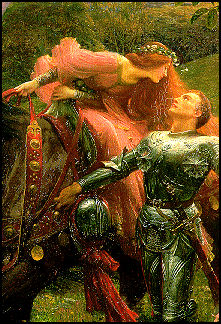 Erec and Enide is a Medieval French romance by a man named Chrétien de Troyes. In it, the handsome prince, Erec, wins his fair bride, Enide, and sets out to live happily ever after.
Then what?
Years later, Enide wakes up and discovers that her handsome prince is no longer the courtly knight he once was. He has given up all his feats of valor to lay abed with her all day. "Your renown has declined," she says. "The very best of knights--the boldest and the bravest, the most loyal, the most courteous that was ever count or king--has completely abandoned chivalry because of me."
Erec and Enide set out on a grand quest to prove Erec's prowess. But on the way, things happen that they don't expect. Their journey becomes, among other things, a beautiful allegory for growth in married life. Together, they learn that happy endings only come to people who continue to work for them every day.
When my now-fiance and I got decided to get married last October, I started searching the Internet for people with stories to tell. So many wedding blogs tell the stories of botched cakes or how to buy perfect wedding dresses. But marriage isn't just for a day. Weddings aren't happily ever afters.
...and Enide is my chronicle, the story of my engagement and, hopefully marriage, to the man I love more than anything in the world--my own quest for a happily ever after. I look forward to sharing my story with you.
You can find out more about Erec and Enide in Arthurian Romances by Chrétien de Troyes, translated by Carleton W. Carroll.
Subscribe to:
Posts (Atom)