Adam and I watched Mamma Mia together three days ago. (I should have posted about it then, but I haven't been feeling very well. Apologies.) Just as I was when I saw the touring show and when I saw the movie the first time, I was again conflicted about the musical's dubious message about marriage.
In the musical, a young bride-to-be invites the three men who might be her father--none of whom she has ever met--to her wedding. Hilarity ensues. At the musical's climax, the protagonist finds herself satisfied with her family background. Her wish to find her family is fulfilled. So she cancels the wedding. She and her fiance won't marry now--they'll see the world together first.
Adam insists that they may well have made the right decision. She was using marriage to fill a whole in her life that she needed to fill some other way. Besides, they're young and may not be ready to spend their lives together yet. After all, he reminds me, we did important things with our lives and put off marriage for three years. People shouldn't rush into marriage.
In a way, I guess he's right. Marriage isn't a decision to take lightly or to rush into. But still, I think the musical portrays a destructive image of marriage. The hero and heroine don't want to go out and follow their dreams separately for a few years, as Adam and I did. They want to explore the world together--but they seem to think of marriage as some sort of impediment. Marriage, to them, seems to be a kind of kill joy, a choice to settle down and stay home after the adventures of youth are over.
That's not how I was raised to think of marriage. My parents have always insisted that marriage is its own adventure but, more than that, their married life has been actively exciting. They've traveled. They've run for public office. They've met the who's who of the Deep South. But the difference between my parents and the couple in Mamma Mia is this: my parents have sought and met adventure as a team. The hero and heroine of the musical go out into the world as separate individuals seeking the same adventures; my parents have done and do it as a single entity with a shared story to tell.
That's what I want for my marriage, too. I'm not ready to give up my adventure--though some might accuse me of being less adventurous than most. I'm ready to join my adventure to Adam so we can pursue our lives, our dreams, our vocations together.
Showing posts with label Review. Show all posts
Showing posts with label Review. Show all posts
Monday, July 13, 2009


Wednesday, June 10, 2009
The Problem of Modern Novels: Howards End and Marriage
If you've ever asked me if I've read a novel, you've probably gotten my token response: "Is the author still alive?" I just don't read modern literature. The snooty Medievalist comes out and wonders, "If it hasn't already withstood the test of time, how do I know it's worth my time to read it?" Besides, modern novels tend to be bleak, depressing with no uplifting moral at the end. They all seem to be about unstoppable decay or the loss of meaning. I don't want to read about those things. How are they going to make me happier or better?
I picked up a copy of E. M. Forster's Howards End from the Chaplaincy library in a moment of desperation for something to read. Being a modern novel, events were sure to disappoint the idealistic heroines who "desired that public life should mirror whatever is good in life within." When Margaret, the earnest protagonist marries the emotionally stunted capitalist, Mr. Wilcox, the reader can almost be ensured of tragedy. Her plan to love him--because "the more she let herself love him, the more chance was there that he would set his soul in order"--is surely set up to fail.
Imagine my surprise and delight to discover that Howards End is nothing I fear in modern novels. Instead of gradually leading readers into disillusionment with Margaret, the narrator helps us to slowly develop a respect for her quiet strenghth. Instead of agnostically challenging the value of love in a modern, transient world, Forster focuses our attention on the ever-increasing importance of marriage and stability. The titular home, Howards End, isn't symbolic for loss of place, as I originally expected. Instead, it's the place where the protagonists "stop," finally finding rest and peace in their love for each other.
In the end, against all odds--and against all of my expectations for a modern novel--Margaret's love really does redeem her husband. Her sisters describes it best: "You picked up the pieces and made us a home. Can't it strike you--even for a moment--that your life has been heroic?" There is something indomitably heroic about Margaret's life. Loving without counting the cost, with perfect faith in the goodness she sees within people if only someone has the patience and courage to draw it out. Nothing turns out for Margaret the way she plans. But, in her unwaivering support for her husband and her family, she makes a happy life for herself.
Adam says I don't like happy stories, but I think he misunderstands. I like stories with substance and meaning--those just often turn out to be the sad ones. I don't like most modern novels, but I do like Howards End. If Margaret's hopes were frustrated, if Forster affirmed the futility of human relationships, it would be a far less true book than it is the way it stands. Margaret has a happy ending, even though its nothing like she expected. And its because she had the courage to love.
I picked up a copy of E. M. Forster's Howards End from the Chaplaincy library in a moment of desperation for something to read. Being a modern novel, events were sure to disappoint the idealistic heroines who "desired that public life should mirror whatever is good in life within." When Margaret, the earnest protagonist marries the emotionally stunted capitalist, Mr. Wilcox, the reader can almost be ensured of tragedy. Her plan to love him--because "the more she let herself love him, the more chance was there that he would set his soul in order"--is surely set up to fail.
Imagine my surprise and delight to discover that Howards End is nothing I fear in modern novels. Instead of gradually leading readers into disillusionment with Margaret, the narrator helps us to slowly develop a respect for her quiet strenghth. Instead of agnostically challenging the value of love in a modern, transient world, Forster focuses our attention on the ever-increasing importance of marriage and stability. The titular home, Howards End, isn't symbolic for loss of place, as I originally expected. Instead, it's the place where the protagonists "stop," finally finding rest and peace in their love for each other.
In the end, against all odds--and against all of my expectations for a modern novel--Margaret's love really does redeem her husband. Her sisters describes it best: "You picked up the pieces and made us a home. Can't it strike you--even for a moment--that your life has been heroic?" There is something indomitably heroic about Margaret's life. Loving without counting the cost, with perfect faith in the goodness she sees within people if only someone has the patience and courage to draw it out. Nothing turns out for Margaret the way she plans. But, in her unwaivering support for her husband and her family, she makes a happy life for herself.
Adam says I don't like happy stories, but I think he misunderstands. I like stories with substance and meaning--those just often turn out to be the sad ones. I don't like most modern novels, but I do like Howards End. If Margaret's hopes were frustrated, if Forster affirmed the futility of human relationships, it would be a far less true book than it is the way it stands. Margaret has a happy ending, even though its nothing like she expected. And its because she had the courage to love.
Saturday, June 6, 2009
Seinen Anime... or More Marriage Advice in Another Unexpected Place
While I'm on the subject of bizarre cross-cultural relations, I may as well bring up another favorite anime/manga, Saikano.
The plot of Saikano sounds about as ridiculous as Onegai Sensei, but the story is much darker. It's about a high school couple in a small Japanese town struggling to cope with life as the world slowly comes to an end--with more of a whimper than a bang. Soon into their relationship, Shuji discovers that the Japanese military is gradually turning his girlfriend, Chise, into a weapon of mass destruction. "The Last Love Song on This Little Planet." That's the subtitle of the series and an adequate summary of what happens next. The world collapses around them as the two fall more and more deeply in love.
Because of it's genre--men in their twenties and thirties are the target audience for seinen manga--it still has a lot of graphic sexual imagery. Also some dialogue nuggets like, "You look nervous. Here, touch my breasts." But, as the story progresses, Shuji learns to reject the part of himself that only wants a physical relationship. More and more, he comes to crave companionship and a meaningful relationship with Chise--all the while, she struggles to remain human enough to reciprocate.
The anime isn't available subtitled in English online, but you can also read my favorite manga chapters here. Shuji and Chise attempt to run away from the military and lead a normal life. There aren't many inhabited towns left, but they find a small fishing village and set up house there. They live together "as man and wife," enacting the future together they so desparately crave. Shuji has to work to support Chise as she gets more and more ill without the military's mechanical support. She's taken care of him, protected him and their town for so long--for the first time, he can take care of her. He watches her body fall apart, revealing the monstrous machine underneath, and he loves her anyway. And, to the end of the Earth, the both remember their time together as the happiest of their lives.
That episode raises some of the same questions I've already been asking about what a marriage is. (See here and here.) Chise and Shuji never undertake a wedding ceremony, but I can't imagine denying that such a couple--so desperately in love, so ready to give their lives for one another, so determined to stay together until the end of time--isn't already married. The series also highlights how important marriage is for basic human existence. Chise and eventually Shuji want nothing more than a home and family. Even when the world is dying, the greatest human tragedy is this: the end of the world means they cannot have a future together.
Again, Saikano isn't a perfect story. But it is a gorgeous story about two people in love, struggling to start and protect a relationship when nothing else is left.
The plot of Saikano sounds about as ridiculous as Onegai Sensei, but the story is much darker. It's about a high school couple in a small Japanese town struggling to cope with life as the world slowly comes to an end--with more of a whimper than a bang. Soon into their relationship, Shuji discovers that the Japanese military is gradually turning his girlfriend, Chise, into a weapon of mass destruction. "The Last Love Song on This Little Planet." That's the subtitle of the series and an adequate summary of what happens next. The world collapses around them as the two fall more and more deeply in love.
Because of it's genre--men in their twenties and thirties are the target audience for seinen manga--it still has a lot of graphic sexual imagery. Also some dialogue nuggets like, "You look nervous. Here, touch my breasts." But, as the story progresses, Shuji learns to reject the part of himself that only wants a physical relationship. More and more, he comes to crave companionship and a meaningful relationship with Chise--all the while, she struggles to remain human enough to reciprocate.
The anime isn't available subtitled in English online, but you can also read my favorite manga chapters here. Shuji and Chise attempt to run away from the military and lead a normal life. There aren't many inhabited towns left, but they find a small fishing village and set up house there. They live together "as man and wife," enacting the future together they so desparately crave. Shuji has to work to support Chise as she gets more and more ill without the military's mechanical support. She's taken care of him, protected him and their town for so long--for the first time, he can take care of her. He watches her body fall apart, revealing the monstrous machine underneath, and he loves her anyway. And, to the end of the Earth, the both remember their time together as the happiest of their lives.
That episode raises some of the same questions I've already been asking about what a marriage is. (See here and here.) Chise and Shuji never undertake a wedding ceremony, but I can't imagine denying that such a couple--so desperately in love, so ready to give their lives for one another, so determined to stay together until the end of time--isn't already married. The series also highlights how important marriage is for basic human existence. Chise and eventually Shuji want nothing more than a home and family. Even when the world is dying, the greatest human tragedy is this: the end of the world means they cannot have a future together.
Again, Saikano isn't a perfect story. But it is a gorgeous story about two people in love, struggling to start and protect a relationship when nothing else is left.
Wednesday, May 13, 2009
An Affair to Remember: A Counter Tragedy
 About four o'clock this morning, I finally realized why the plot of Casanova seemed hauntingly familiar. It's because I've seen that story before--two people making their livings off of the misplaced affections of others fall hopelessly, and impractically, in love. That's the basic plot of one of my very favorite films, An Affair to Remember. But where in Casanova the characters' unwillingness to live a life of hardship and sacrifice makes the tale a tragedy, the choices of the characters in An Affair to Remember make it an uplifting story of the redemption of selfless love.
In An Affair to Remember, two people meet aboard a trans-Atlantic cruise. One is an artist-turned-playboy, now engaged to an heiress. The other is a lounge singer and live-in girlfriend of a wealthy businessman. The man takes the woman to meet his grandmother on an Italian island, one of the ship's ports-of-call. While there, they both stop and pray in the family chapel. That moment they drop their guards, see each other as they really are, and begin to fall in love. When the cruise ends, they decide to meet in sixth months. If they've successfully turned their lives around, they will marry. Instead of running back to safety and security, as Casanova and Henriette would have done, these two leave their lovers and set off to become independent, to redeem their past lives of indolence and questionable morals, and to make themselves worthy of the love they share.
That's what love is. They never pine or mourn or even complain about the situation. They give in to the transformative power of love. They take great pride and pleasure in their growing abilities to take care of themselves and to make moral choices. Love makes them want to be better than they were before. And the process is cyclic. The better they become, the more they love; the more they love, the better they become.
That process, of love refining my personality and inter-personal interactions, is what I enjoy most in my relationship with Adam. Over all our time apart, I've gradually noticed how much more difficult it is to be nice to people and to use my time in efficient ways. It's part of why I feel so comfortable in my vocation to marry him: being with him makes me better. Not being with him makes it more difficult to be good.
As much as I empathize with Casanova and Henriette, it's an empathy born of the knowledge that they've made a tragically wrong choice. They've chosen to remain static, unchanged by the powerful impulse of love which leaves people with little choice but to grow better. That's what I have with Adam and what I hope we'll never lose.
Tuesday, May 12, 2009
Casanova: A Tragedy
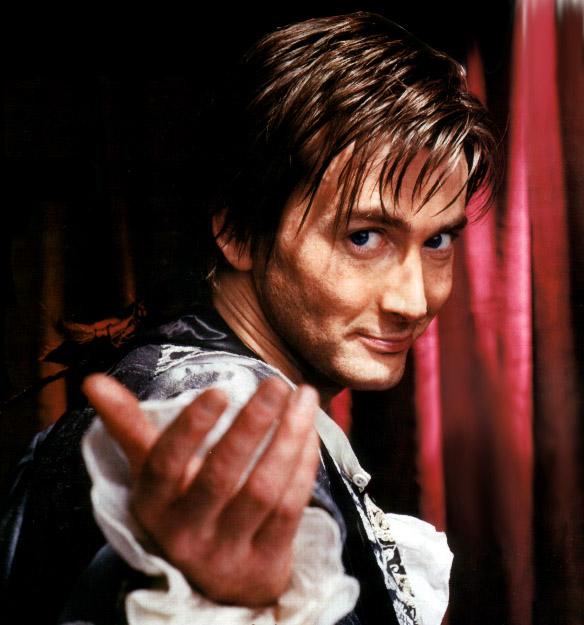 I spent more time than I ought to have today watching a 2005 BBC production of Casanova. David Tennant, of Doctor Who fame, played the world's most famous lover. The chronicle of his youthful exploits was delightful, but it was the frame narrative that really made the mini-series worth watching. Peter O'Toole plays Casanova in his old age, withered and spent. Amidst all his lovers and all his conquests, O'Toole's Casanova ends his life alone and almost forgotten.
In the BBC production, Casanova's actions revolve around Henriette, his one great love, and his inability to ever be with her. The one that got away. The one woman whom he loves too much to seduce. His whole being revolves around her. No matter how many terrible choices he makes, his love for her stands out as the redeeming quality of his life. His enduring, unrequited love, destined never to be fulfilled.
Henriette loves him, too, but craves a life of stability and prosperity. She once vowed to herself she would never live in poverty again, as she had in early life, nor raise children in an unstable environment. For her own sake, and for the sake of her children, she chooses stability over love.
A few days ago, I posted about how irrevocably linked I already am to Adam. From that standpoint, Casanova's struggles become gut-wrenching. I can't imagine a life of constantly reaching out for Adam, barely missing him. Worse yet, I can't imagine Henriette's life--a marriage of convenience to a man she doesn't love, always wishing she could have been with another.
What would life be like, spending it without the one I love, my soul mate? How would my life change if Adam and I weren't set up to be independent? Could I always choose Adam over every other thing? What would happen to me, to us, if I couldn't? These are the questions Casanova forced me to ask myself.
But I don't think those questions give me enough credit. I know what I would choose. I would choose a life of poverty over a life without Adam, hands down. A life of scandal and a life of hardship, too. I could never choose the kind of tragic life Henriette chooses for herself, and for Casanova. I don't think there is anything on this earth more important to me than love, and unity, with Adam. I think that's the way marriage is supposed to work, isn't it?
Friday, April 24, 2009
Giselle
Several friends and I went to see the ballet Giselle last night to celebrate my twenty-fourth birthday. Giselle is the "quintessential romantic ballet." It tells the story of a young nobleman in disguise and the naive village girl who falls in love with him. She abandons her betrothed for love of him and then dies of grief when she discovers his identity and meets his fiance. In the second act, she finds herself a member of the beautiful and terrible wilis, ghosts of women abandoned on their wedding day who dance unsuspecting men to death. Even in death, she saves her lover from dying at their hands by prolonging his execution until the sun rises and the wilis disappear.
My friend Tom and I had a rare disagreement about the ballet. He was critical of the young man, just another incarnation of the nobility-loves-then-abandons-peasant motif. Her furtive defense of him is supposed to pique the audience's anger for him and sympathy for her. But I don't think Tom's got this one right.
The choreography of Giselle is singularly playful in a way I've never seen. The first act, the chronicle of the couple as they fall in love, lacks the sultry pas de deux of other ballets. Ballet has ample physical means to portray the attraction of a lusty nobleman to a virginal peasant. Giselle exploits none of it. Instead, their courtship looks like what it is: a perfect visual demonstration of what it is to fall in love.
Her pursues her, she resists. He pursues her with greater zeal, she yields. She turns her happy solo, peasant dance into an integrated pas de deux with him. He seems truly caught up in her, and in her world. When the noblemen discover him, he fiercely resists reclaiming his place among them.
And then there's the way the nobleman responds to Giselle's death. It is far more than Tom's proposed "guilt, but not penance" for what has happened. His pitiful and poignant response to Giselle's body is moving and sincere. Later, it is only because he seeks to keep vigil over her body that he is put at risk by the wilis at all. At the end of the ballet, the nobleman and Giselle's final separation is gut-wrenching as the very-real specter loses form and disappears.
To me, at least, the love between the pair seems very real. The playfulness of their courtship captures exactly the way I feel about Adam. At our best, we are capable of all the gay joility of the dancing pair. Being with him is just that much fun. And the intensity of the longing between them, knowing they will never be together, evokes the way I feel every time I'm separated from Adam--irrepresible longing.
Most importantly, the emotion in the ballet isn't one-sided the way it so often is. In the choreography, Giselle loves and is loved in return. That's the most shocking, and important, thing I always have to remember about the love between Adam and me: he loves me, too.
This clip, from the second act, captures the couple in both their plaintive and playful moods.
Incidentally, you can see what would have happened to Giselle's lover/my favorite moment of the ballet here.
My friend Tom and I had a rare disagreement about the ballet. He was critical of the young man, just another incarnation of the nobility-loves-then-abandons-peasant motif. Her furtive defense of him is supposed to pique the audience's anger for him and sympathy for her. But I don't think Tom's got this one right.
The choreography of Giselle is singularly playful in a way I've never seen. The first act, the chronicle of the couple as they fall in love, lacks the sultry pas de deux of other ballets. Ballet has ample physical means to portray the attraction of a lusty nobleman to a virginal peasant. Giselle exploits none of it. Instead, their courtship looks like what it is: a perfect visual demonstration of what it is to fall in love.
Her pursues her, she resists. He pursues her with greater zeal, she yields. She turns her happy solo, peasant dance into an integrated pas de deux with him. He seems truly caught up in her, and in her world. When the noblemen discover him, he fiercely resists reclaiming his place among them.
And then there's the way the nobleman responds to Giselle's death. It is far more than Tom's proposed "guilt, but not penance" for what has happened. His pitiful and poignant response to Giselle's body is moving and sincere. Later, it is only because he seeks to keep vigil over her body that he is put at risk by the wilis at all. At the end of the ballet, the nobleman and Giselle's final separation is gut-wrenching as the very-real specter loses form and disappears.
To me, at least, the love between the pair seems very real. The playfulness of their courtship captures exactly the way I feel about Adam. At our best, we are capable of all the gay joility of the dancing pair. Being with him is just that much fun. And the intensity of the longing between them, knowing they will never be together, evokes the way I feel every time I'm separated from Adam--irrepresible longing.
Most importantly, the emotion in the ballet isn't one-sided the way it so often is. In the choreography, Giselle loves and is loved in return. That's the most shocking, and important, thing I always have to remember about the love between Adam and me: he loves me, too.
This clip, from the second act, captures the couple in both their plaintive and playful moods.
Incidentally, you can see what would have happened to Giselle's lover/my favorite moment of the ballet here.
Subscribe to:
Posts (Atom)