Showing posts with label reflections. Show all posts

Tuesday, June 9, 2009

Oxford: A Reflection on Gratitude


A priest recently assigned me to sit and think of the people and experiences I'm grateful for in Oxford. I suppose it's a really good exercise for life, to accept where we are and love life the way it is. So, here's a list (in no particular order) of some of the things about Oxford I'm most grateful for:
  • Oxford is truly beautiful. I've never lived somewhere with this much architectural beauty--and probably never will again. It's taught me to pay more attention to beauty in my daily life, not to overlook it as common-place.
  • For the first time in my life, I have a wonderful group of female friends. Making female friends has been a real challenge for me all of my life. I feel so immensely grateful for the women I've met here and their acceptance.
  • I've been a part of a wonderful Christian community this past year. I prayed so hard for one last year. I often felt lost and alone. This year, I've felt the love and support of the Catholics and the chaplaincy and many of my Christian coursemates.
  • All of my coursemates are awesome and amazing. I'm always grateful for the chance to be around other clever people. It helps me keep my own life and education in perspective.
  • CLC has changed my life.
  • I would never have gotten involved in ballet if it wasn't for the Oxford University Dance Society. Dancing on stage was an amazing experience. I am strong and flexible as I've ever been. And I've learned to truly love ballet, as a performer and a spectator.
  • I'm so glad to have been able to learn so much about English culture! Beans on toast... Doctor Who... tea... But I'm grateful for the subtle ways being in England has affected my American psyche. I don't feel rushed urgency the way I used to. It's a habit I hope I can keep.
  • Most of all, I've made friendships that I hope will last a lifetime. So many of my Oxford friends have already changed my life.
The last week has been pretty difficult. I'm feeling desperate to finish my dissertation, be with Adam again, and to get on with my life. But this is my life right now. And it's beautiful.

(Sorry for the quality of the recording of my favorite pep song. They sound WAY better on the CD!)

Monday, June 8, 2009

Regret

If being away from Adam has done anything for our relationship, it's better taught me the value of every moment with him. So, on those days I miss him the most, it's easy to get bogged down in the times I've wasted his affection or a moment I could have shared with him.

The worst are the memories of times I was cruel. I laughed a haircut he got to make me happy. I used his sweaters, the ones I liked the least, to mop up mess from the exploded dishwasher. I almost threw a shoe through his window. These are all funny stories now, but tinged with a hint of regret. God gave me a moment to love and I said no. There's no going back.

But I regret, too, the moments I wasted with Adam, back when we had all the time in the world together. The days neither of us did anything wrong except not enjoying each others' company. He made a picnic for me on a day I wanted to go to a movie, so I pouted. I offered to take him to see Tommy, but he wanted to stay in. Believe it or not, one of my biggest regrets is not taking him up on a dinner to Carrabas before we started dating. Those are moments, moments that could have been special but have been lost forever.

I guess we're lucky. We know now what are lives are like without each other. We've decided we don't like them that way. I hope that, even as the years pass, we'll remember how much every moment together used to mean to us. Life really isn't the same without him.

In a fairy tale my mother used to read to me, a father failed to understand his daughter's claim that she loved him "more than meat loves salt." I do love Adam more than meat loves salt and my life lacks savor without him.

Friday, May 22, 2009

Epic Fail


Today I had the distinctively unpleasant opportunity to be reminded of one of my greatest flaws: I hate to lose. I hate not being at the top of the class. Not being the greatest and best at everything I do.

Over the years, I'd like to think I've improved. Now that I've learned to better love and respect the people around me, I'm usually very happy when they do well--even when it's better than me. But I still can't stand the idea that my performance was sub par, that I could have done better.

It occurred to me how dangerous my attitude toward failure may be for the future of our marriage. What happens when something goes wrong? Am I going to try to hide it, pretending it doesn't exist so I don't have to admit I might have failed? Or will I quit? Just get up and leave out of a fear I might not succeed at "this marriage thing" after all?

Of course, failure isn't the same for married Catholics. Divorce isn't an option. But separation is. Even worse, so it deep-seated unhappiness and resentment. My fear of failure, left unchecked, could easily become a self-fulfilling prophecy if it forces me to stop communicating with Adam.

No, I haven't failed anything today per se. I've only disappointed myself. Maybe in the long run it's far better to be reminded of my very human shortcomings in a context where the stakes aren't very high.

Wednesday, May 13, 2009

An Affair to Remember: A Counter Tragedy

About four o'clock this morning, I finally realized why the plot of Casanova seemed hauntingly familiar. It's because I've seen that story before--two people making their livings off of the misplaced affections of others fall hopelessly, and impractically, in love. That's the basic plot of one of my very favorite films, An Affair to Remember. But where in Casanova the characters' unwillingness to live a life of hardship and sacrifice makes the tale a tragedy, the choices of the characters in An Affair to Remember make it an uplifting story of the redemption of selfless love.

In An Affair to Remember, two people meet aboard a trans-Atlantic cruise. One is an artist-turned-playboy, now engaged to an heiress. The other is a lounge singer and live-in girlfriend of a wealthy businessman. The man takes the woman to meet his grandmother on an Italian island, one of the ship's ports-of-call. While there, they both stop and pray in the family chapel. That moment they drop their guards, see each other as they really are, and begin to fall in love. When the cruise ends, they decide to meet in sixth months. If they've successfully turned their lives around, they will marry. Instead of running back to safety and security, as Casanova and Henriette would have done, these two leave their lovers and set off to become independent, to redeem their past lives of indolence and questionable morals, and to make themselves worthy of the love they share.

That's what love is. They never pine or mourn or even complain about the situation. They give in to the transformative power of love. They take great pride and pleasure in their growing abilities to take care of themselves and to make moral choices. Love makes them want to be better than they were before. And the process is cyclic. The better they become, the more they love; the more they love, the better they become.

That process, of love refining my personality and inter-personal interactions, is what I enjoy most in my relationship with Adam. Over all our time apart, I've gradually noticed how much more difficult it is to be nice to people and to use my time in efficient ways. It's part of why I feel so comfortable in my vocation to marry him: being with him makes me better. Not being with him makes it more difficult to be good.

As much as I empathize with Casanova and Henriette, it's an empathy born of the knowledge that they've made a tragically wrong choice. They've chosen to remain static, unchanged by the powerful impulse of love which leaves people with little choice but to grow better. That's what I have with Adam and what I hope we'll never lose.

Tuesday, May 12, 2009

Casanova: A Tragedy

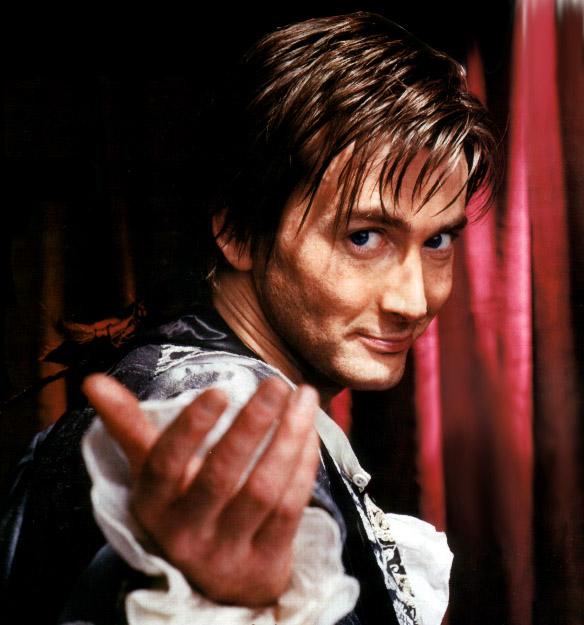
I spent more time than I ought to have today watching a 2005 BBC production of Casanova. David Tennant, of Doctor Who fame, played the world's most famous lover. The chronicle of his youthful exploits was delightful, but it was the frame narrative that really made the mini-series worth watching. Peter O'Toole plays Casanova in his old age, withered and spent. Amidst all his lovers and all his conquests, O'Toole's Casanova ends his life alone and almost forgotten.

In the BBC production, Casanova's actions revolve around Henriette, his one great love, and his inability to ever be with her. The one that got away. The one woman whom he loves too much to seduce. His whole being revolves around her. No matter how many terrible choices he makes, his love for her stands out as the redeeming quality of his life. His enduring, unrequited love, destined never to be fulfilled.

Henriette loves him, too, but craves a life of stability and prosperity. She once vowed to herself she would never live in poverty again, as she had in early life, nor raise children in an unstable environment. For her own sake, and for the sake of her children, she chooses stability over love.

A few days ago, I posted about how irrevocably linked I already am to Adam. From that standpoint, Casanova's struggles become gut-wrenching. I can't imagine a life of constantly reaching out for Adam, barely missing him. Worse yet, I can't imagine Henriette's life--a marriage of convenience to a man she doesn't love, always wishing she could have been with another.

What would life be like, spending it without the one I love, my soul mate? How would my life change if Adam and I weren't set up to be independent? Could I always choose Adam over every other thing? What would happen to me, to us, if I couldn't? These are the questions Casanova forced me to ask myself.

But I don't think those questions give me enough credit. I know what I would choose. I would choose a life of poverty over a life without Adam, hands down. A life of scandal and a life of hardship, too. I could never choose the kind of tragic life Henriette chooses for herself, and for Casanova. I don't think there is anything on this earth more important to me than love, and unity, with Adam. I think that's the way marriage is supposed to work, isn't it?

Wedding Ethics

Last term, I posted about a "Catholicism and Economics" reading group I've been attending at the Chaplaincy. I joined the group hoping to get a better handle on my own buying decisions. I know that statement seems a bit pretentious, so please let my try to explain.

In a Capitalist market, I, as a consumer, have many buying choices. But with those choices comes a certain responsibility. If, for example, I buy clothes only from stores that mass produce, I'm contributing to the downfall of local enterprise. If I buy milk in a plastic jug, I'm telling milk farmers that biodegradable materials aren't important to me. And so forth...


Ultimately, I've deduced that responsible buying means never putting price at the top of my list of priorities. When I buy something, it ought to be the best value, not the cheapest product available. A hand-made skirt from Etsy might cost more, but it will probably last longer than one from Target--and it was made by a small-scale producer working in an environment where she could take a sense of pride and accomplishment in her work, rather than mass-produced in an impersonal factory.

But knowing price can't be my highest priority is only the first step. I have to decide what does matter to me. What labels do I look for? Sustainable? Hand-made? Local? Organic? Fair trade? On top of that, how much can I cut down on my consumption--period--regardless of a products "localness" of "sustainability"? Suddenly moral buying decisions become more complicated than I ever anticipated them being.


These are the sorts of questions Adam and I have increasingly been asking ourselves about the way we spend our money. It's difficult, but we're trying to take buying decisions seriously. In a Capitalist market, its the best way we have to tell producers what's important to us.
The way we spend our money ought to reflect what we find important. That's why we've tried to take those kinds of factors into consideration when planning our wedding.

"Ethical weddings" have come into vogue in the past few years. Dozens of websites, like
EthicalWeddings.com, offer brides thousands of suggestions from serving a vegan/organic brownie wedding cake to packing your entire bridal party onto a London bus to save on CO2 emissions. The massive lists suggestions is alarming... and guilt-inducing. In the end, I think it's important for me to accept that the buying decisions I make for my wedding, and my life, are never going to perfectly reflect my values. There's just no realistic way to always choose the "most ethical" product in a market with this many choices. Still, I'm happy with the little ways we've been able to incorporate ethical buying decisions into our wedding:
  • We hired a local, small-scale caterer and baker. Our caterer is a friend of my mom's. I'm very excited to be working with someone with whom we have a personal relationship.
  • We chose to have fewer flowers, and flowers which are not difficult to find. By cutting the number of flowers, we saved a lot of money. We were also able to get flowers that are seasonal, which cuts down on CO2 emissions racked up in shipping plants.
  • We are having our invitations hand-made by an Etsy artisan. As a bonus, she's also using paper from sustainable forests. You can read more about our invitations here.
  • I bought a dress from a small, local store. Again, going local has been a good move. The shop attendants at Natalie's Bridal have been incredibly helpful. They're even communicating with me over the internet about my veil.
  • And we've stayed in budget! Adam and I really wanted to stay in budget as a sign of respect and gratitude to my parents for paying for our celebration.
Can you think of other ways we could make our wedding a little better?

Thursday, May 7, 2009

A Walk to Remember: or, When Is a Marriage a Marriage?

I finished watching Doctor Who on BBC iPlayer two days ago. So, when I needed something else to do to waste my time, I found myself fumbling through You Tube for old movies. That's how I ran into A Walk to Remember.

Just in case you missed the 2002 teenage romance, allow me to fill you in. Landon, a popular, somewhat troubled high school boy gets stuck doing community service for his school. In the process, he finds himself spending more and more time with Jamie, the socially outcast, devoutly Christian, minister's daughter. He is initially embarrassed to be seen with her, but slowly learns to admire her quiet faith and conviction to do good. Ultimately, he finds himself in love with her and the life-affirming presence that she represents. She surprises herself by loving him back.

As the story moves towards its climax, it is obvious that something is terribly wrong. "I'm sick," she confesses to him, "I have leukemia." Although he is first devastated and resentful, he resolves himself to helping her through the terrifying experience of death by disease.


What makes the picture particularly beautiful is the way in which he helps her. Earlier in the film, she admits to him that she keeps a "to do list" of all the things she wants to accomplish before she dies. With an unexpected sense of urgency, he helps her with as many of them as he can as her health slowly deteriorates. He takes her to the state line so she can be in two places at once. Her helps her apply a temporary tattoo. He even builds her a telescope so she can observe a comet.

But the most beautiful moment in the film is the moment he asks her to help him meet the goal highest on her list: she wants to get married in her mother's church. She agrees. They marry. And she dies at the end of the summer.

After I finished hysterically crying, the film forced me to think about some of my own less-than-orthodox questions about marriage.

Landon and Jamie truly love each other. Each values the other over his or her own happiness. Their love makes them better, and makes the people around them better, too. They are a
part of one another, long before he asks her to marry him. Why aren't they married already? What has the ceremony changed?

As a medievalist, the answer is not as straightforward as you might think. Historically speaking, marriage just requires the consent of two adults in front of witnesses. There are medieval anecdotes of parents who catch their daughters in bed with men. They tell her parents they plan to marry. The parents go back downstairs, considering the marriages valid and binding--which, for all intents and purposes, they were. Even now, the Church recognizes that the priest doesn't administer the sacrament of marriage at all--the couple administers it on themselves. The Church doesn't make two people one: two people decide to become one. All silly anecdotes aside, mutual love and commitment make a marriage, not a priest.

Given that fact, it's difficult to determine what makes the significant difference in what a marriage is if it performed in a church in front of a priest. Landon and Jamie gives themselves to one another a long time before their wedding takes place. And Adam and I decided to become one, to give our lives to each other, a long time ago. I feel irrevocably bound to Adam already. It's virtually impossible to believe either of us could walk away at this point without leaving a piece of ourselves behind.

Obviously there are problems with marriage purely by intention, else the Church wouldn't have bothered to clarify. Marriages require the formal sanction of the Church for our own sakes, to protect the sacramental and legal validity of our marriage. How else can they assure that neither partner is being coerced or misled. Plus, marriage is more than just the formal commitment in ways that Jamie and Landon, and Adam and I, haven't satisfied. I plan to follow the traditions of the Church and to continue talking about and treating Adam as my fiancé, rather than as my husband. Still, the three months that stretch before us seem like an endless formality given what we already spiritually share.

I posted a few weeks ago about what engagement is. I suppose that deserves a clarification. Adam takes the idea of engagement more seriously than I do, but that doesn't mean I'm any less committed to him than he is to me. We are, as I believe many couples are, more than engaged. We've already given our lives to each other. We're just waiting to close the deal.

Please do comment if you have any insight! I know I'm not being particularly orthodox. I'd love to better understand what marriage means.

Monday, May 4, 2009

Blogging: A Moral Question

A friend of mine asked me today whether I thought "the sudden and dramatic explosion" of blogs was "a good thing." His question tapped into a issue I've spent a lot of time thinking about over the past few days. What is the value of keeping a blog?

We all know that blogs come in all shapes and sizes. Some make us more aware of the world around us. Others are simply fun. And some are stream-of-consciousness journals, unedited accounts of those willing to bare their souls for the world to see. All of us are asserting ourselves in a vast, world-wide medium, competing for our moment on the LCD screen. What's one more drop in a pond that vast?

In the end, I guess I just like stories. I like to read them, to study them, to tell them, and to write them. Stories mean something. They gives us a vocabulary for understanding our own lives. Sometimes, just reading a story can liberate us, set us free to think about our selves and our experiences in ways we never thought possible. They help us to step outside ourselves, to see our actions in the stories' characters, helping us to understand who and what we are.

Stories, too, shape the narratives of the lives we lead. What teenage girl hasn't pined away for a great unrequited love just because that's what teenaged girls do in stories? Better yet, what child hasn't whispered "I think I can" to herself the first time she rides a bicycle? And what Dickens reader has read the final scene of A Tale of Two Cities without the instant to go and do some "far better thing" of his own?

Best of all, a story has its own, external existence. Romeo and Juliet is timeless because of what it shares with no many stories of tragic love, both real and fictional. Dante's Commedy remains relevant because a struggle with faith is a common human experience. Hundreds of stories get retold on paper and on the stage of the world around us every day. We share the narratives that run through our lives with billions of other people in human history. No two people share the same narrative threads, but those threads create a vast and intricate web connecting all of human history. That's why reading really can make us more human. We all have our own stories. But we are never truly alone because there is never a new story.

So ...and Enide is my attempt to tell my own story--a story I share with hundreds of other people, but told in a way that's uniquely my own. My blog is my quest to find others like me who share tales of prince-like lovers or of conquering their own personal monsters. It's my quest to shape my own engaged, and later, married life into the patterns of Enide, Jo March, or even my parents--patterns that work. And it's my quest to share my story with people still writing their own stories in the hope it will help them understand their own.

No, I don't think that "the sudden and dramatic explosion" of blogs is "a good thing." Or at least not necessarily. In fact, my blog--my story--may not mean what I would like it to mean to anyone else but me. Still, I do believe there is a value in people telling their stories in a medium free from the struggle to be profitable or trendy. And whether they are interesting or not, stories almost always have a value. I hope you, as a reader, continue to find some value in mine.

Sunday, May 3, 2009

My "Not Me"

Hello, my non-self. Let's get something straight here: my friends don't hate me. You hate me. Go away. I don't like you. I am not the person you want me to be, and I will never be the person you want me to be.
A friend of mine wrote a very interesting blog post a few weeks ago about her "not me." She defined it as a part of herself that occasionally takes control , convincing her that she is unloved and unlovable. I thought the phrase was profoundly true and helped me to explain some of my own experiences.

You see, I have a not me, too. She cyclically affects the way I treat other people, making me grumpy, irritable, and even less tactful than normal. She also makes me cry at the drop of a hat. Worst of all, though, she tricks me into an exaggerated perception of how unfit I am for human companionship. Suddenly, the friendships I felt to be strongest just the day before are threatened: any moment, my closest friends may figure out who I really am and leave me on my own.

In five and a half years of dating, Adam has never gone anywhere.

In fact, it's largely to his credit that I've learned that the "not me" never tells the truth.

Adam used to fight with the "not me" all the time. It isn't his fault. He simply didn't know she existed. I finally admitted her to him. I expected him to bitterly put up with her a few days a month at best or break up with me rather than go through the trouble at worst. He did neither. Instead, he's shown love and support for me at almost every opportunity. He watches for her, for the moments I feel unloved or unworthy, and treats me with a special respect and kindness. He even gently helps me keep my grumpy behavior in check, knowing how painful the memory of it will be to me later.

The best part is, Adam has never once denied that the "not me" exists. He never scoffs at me, or jokes about my "woman troubles." He knows that my feelings and fears are, no matter how artificial, absolutely real to me in the moment. He never ignores the "not me." And he never shows any resentment toward her. He loves her because he loves me, and she's a part of who I am.

"Not me" is a part of my life that may never go away. But because Adam loves her, I, too, have stopped dreading her return quite as much as I once did. It helps to have Adam's outside perspective that, no matter how bad things seem now, everything will be normal again in a few days. Besides, knowing that Adam loves even this worst facet of myself means that my greatest "not me" fears will never come true: with Adam, I'll never truly be alone.

Saturday, May 2, 2009

A Mixed Marriage?

Time and time again over the past few months, I've excitedly invited a friend to join Adam and I in our new, Washington, DC home. Most people face me with blank stares or, at best, a sort of vague threat: "Don't say that if you don't mean it." My friends don't seem to realize how fundamentally important hospitality is to me, and to Adam.

Even though Adam and I are of the same race and the same nationality, we come from rather fundamentally different cultures. I'm from the American South, while he's from the American West with Yankee parents to boot. Still, Adam violates every Southern expectation of Yankee behavior on at least one point: hospitality.

Southern hospitality is one of my very favorite features of my culture. It's generosity and communal spirit in action in a vitally important way. That why it's so very important to me that Adam is not just an excellent host, but one who enjoys it. For both of us, sharing our food with other people is energizing and uplifting, as is opening our home to others.

When Adam and I sat down to think about our priorities in marriage, it made me really happy that we both included having an open, welcoming home on the list. That's part of the reason we chose our New Testament reading, from Hebrews 13: "Do not neglect hospitality, for through it some have unwittingly entertained angels."

And, for the record, our home will always be open to you.

Thursday, April 30, 2009

Flippancy and Swine Flu

Adam's attitude toward tragedy and death has always been an annoyance, and a bit of a concern. Who wouldn't wonder about a true lover who could stone-facedly speak about your hypothetical death as "God's will." I share my deepest, most painful paranoid delusions about losing him with him and he responds, "Well, I'll be happier with God anyway."

On reflection, I know he's right. Infuriatingly right. But it's never made his attitude any easier to bear. I want the idea of losing me to be painful to him. How else do I know he really cares about me.

The mass hysteria about the swine flu has really opened my eyes to his way of thinking. I hate feeling helpless, but there is so little I can do about a global pandemic that it seems silly to even waste time thinking about it. The English National Health Service speaks about a global flu pandemic as inevitable. Why worry about what I can't stop.

From within this context--facing a frightening, world-wide disease I cannot stop--Adam's attitude suddenly becomes clear. It's not that he doesn't, or I don't, care about what happens. We love each other, the life we're going to live together. But why spend time worrying about what we can't stop? And what's the point of believing in a God who saves and a perfect afterlife if I'm going to fear death?

Wednesday, April 29, 2009

Honest Blog

As you may have noticed, I've been doing more and more reading at Wedding Bee. They've got a nice balance of bits-and-bobs posts about wedding planning and serious posts about "marriage planning," so to speak.

This post really spoke to me. The blogger's concern about how her own personal failings might affect her marriage seem really familiar.

Sometimes I just want a knight. I want to be saved. I want to be needed and wanted and adored. I want someone to think of me first. I want someone else to figure things out. I want to be cherished. I want someone to come to my rescue. Unfortunately, those times seem to be when my beloved wants all those things too...

I've posted about my favorite story of knighthood, Erec and Enide nore comprehensively before. Erec and Enide are lovers in a medieval French romance. Erec wins a tournament, defends Enide's honor, and they are both happily married. But, years later, Erec discovers that Enide doesn't think he's quite the man he once was. Together, they set out on a grand quest to prove Erec's prowess. Along the way, they learn many valuable lessons about themselves, and each other.

Adam really is my knight, my Erec. Like Enide, I've had to gradually learn to trust him. Like Enide, I've had to learn never to undermine his masculinity by doubting his willingness or ability to take care of me.

He's had to learn lessons, too. Like Erec, he's had to learn that simply being a masculine hero isn't enough. Like Erec, he's had to learn that I'm not just his lover--I'm his partner.

But perhaps the most important lesson is the one we've learned together: even though they have different needs and desires they don't always understand, Erec and Enide are always best when they're putting their lover ahead of themselves. We both want to be loved and cherished in our own special way. We'll be happiest when we do that for each other.

Monday, April 27, 2009

Ballet: The Arisotelian Exercise

I know I still have entries on our Engagement Encounter pending, but I thought I would write a post I've been meaning to write for a while now as a follow-up to my review of Giselle.

As an undergraduate, I read a lot of Aristotle. I'd like to think that The Nicomachean Ethics and The Politics have played a large and important role in making me who and what I am today. In The Nicomachean Ethics, Aristotle brings readers to two important conclusions which I always try to keep in mind. First, the end of human life is happiness. Second, humans become happy by becoming good.

Of course, as anyone who has ever made a resolution knows, we can't merely choose to be good. Choices don't work like that. Every action is really a chance to choose what's good. We become good by choosing the good again and again and again. This process, the habituation to virtue, is the path to happiness in life.

If you've looked at the title of this post, you may ask yourself what this has to do with ballet. I'd never considered the connection either. I started dancing about a year ago, purely on a whim conjured up by one of my favorite animes. I knew Adam and I were headed in the direction of marriage, and I wanted to get in shape. Ballet is a wonderful way to build muscle tone without (if I avoided the anorexic that often plagues professional dances) losing the feminine curves I love in the way I look.

I started dancing and slowly grew to love it. For the first time ever, I could see the changes exercise was bringing about on my body and on my mind. Plus, it's a lot of fun turning your first successful pirouette. Then, sitting in on a rehearsal of the English National Ballet last fall, I realized ballet's real virtue.

Before that rehearsal, I'd never known that every company, no matter how professional, begins every day with a class. And every dancer, no matter how talented, fills each class with the same basic techniques, albeit at greater or lesser levels of difficulty. Every single dancer begins his or her days with plies, simple bendings of the knees. That's it. Ballet teaches by repetition, developing muscle and skill by performing the same movements over and over again.

Viola! Aristotelian exercise. By habituating my body to physical virtue, I found myself suddenly liberated physically in a way I never have before. I'd started this regime to look better for Adam. Now, I find myself stronger, more flexible, and happier about my body and its abilities than I've ever been before.

I think Adam felt challenged and inspired by how happy I was with ballet and decided that was something he wanted for himself, and to share with me. Although ballet isn't so much of an ideal exercise for a 6'6" man with a fused spine, he has found his own ways to build muscle and flexibility. When I saw him a few weeks ago, it was the first time in almost six years of knowing him that he's seemed pleased by what his body can do. It was a real treat to see the joy in his face at overcoming some of the physical limitations which have challenged him since his back surgery almost eight years ago. He's giving such a wonderful gift to me: a strong, healthy body with a better chance of lasting the lifetime I want to spend with him.

Dancing has turned out to be a joy and blessing I never expected. I feel stronger, lighter, healthier, and happier with myself than I ever thought I would. And those things are all gifts I'm excited to give to Adam. So ballet has turned out to be the ideal Aristotelian exercise, leading me to a kind of virtue and through that virtue toward happiness.

If you're in the Oxford area and interested in ballet, I'd like to invite you to our upcoming ballet performance on Friday and Saturday of fifth week. Please e-mail me if you have any questions or would like to purchase a ticket.

Friday, April 24, 2009

Giselle

Several friends and I went to see the ballet Giselle last night to celebrate my twenty-fourth birthday. Giselle is the "quintessential romantic ballet." It tells the story of a young nobleman in disguise and the naive village girl who falls in love with him. She abandons her betrothed for love of him and then dies of grief when she discovers his identity and meets his fiance. In the second act, she finds herself a member of the beautiful and terrible wilis, ghosts of women abandoned on their wedding day who dance unsuspecting men to death. Even in death, she saves her lover from dying at their hands by prolonging his execution until the sun rises and the wilis disappear.

My friend Tom and I had a rare disagreement about the ballet. He was critical of the young man, just another incarnation of the nobility-loves-then-abandons-peasant motif. Her furtive defense of him is supposed to pique the audience's anger for him and sympathy for her. But I don't think Tom's got this one right.

The choreography of Giselle is singularly playful in a way I've never seen. The first act, the chronicle of the couple as they fall in love, lacks the sultry pas de deux of other ballets. Ballet has ample physical means to portray the attraction of a lusty nobleman to a virginal peasant. Giselle exploits none of it. Instead, their courtship looks like what it is: a perfect visual demonstration of what it is to fall in love.

Her pursues her, she resists. He pursues her with greater zeal, she yields. She turns her happy solo, peasant dance into an integrated pas de deux with him. He seems truly caught up in her, and in her world. When the noblemen discover him, he fiercely resists reclaiming his place among them.

And then there's the way the nobleman responds to Giselle's death. It is far more than Tom's proposed "guilt, but not penance" for what has happened. His pitiful and poignant response to Giselle's body is moving and sincere. Later, it is only because he seeks to keep vigil over her body that he is put at risk by the wilis at all. At the end of the ballet, the nobleman and Giselle's final separation is gut-wrenching as the very-real specter loses form and disappears.

To me, at least, the love between the pair seems very real. The playfulness of their courtship captures exactly the way I feel about Adam. At our best, we are capable of all the gay joility of the dancing pair. Being with him is just that much fun. And the intensity of the longing between them, knowing they will never be together, evokes the way I feel every time I'm separated from Adam--irrepresible longing.

Most importantly, the emotion in the ballet isn't one-sided the way it so often is. In the choreography, Giselle loves and is loved in return. That's the most shocking, and important, thing I always have to remember about the love between Adam and me: he loves me, too.


This clip, from the second act, captures the couple in both their plaintive and playful moods.

Incidentally, you can see what would have happened to Giselle's lover/my favorite moment of the ballet here.

Wednesday, April 22, 2009

Revolutionary Road

Although I have many happy things to write about from my vacation (including my first dress fitting) and my trip to DC with Adam (including our first meeting with the priest, an Engagement Encounter weekend, and apartment shopping), I find that it's always easiest to write what's fresh. And I have something slightly less sunny on my mind.

Revolutionary Road reunites Kate Winslet and Leonardo DiCaprio in a dark sketch of married life. DiCaprio plays a disillusioned thirty-year old working in a job he hates to support the family he has been compelled--half by his own desire and half by social pressure--to start. Winslet matches him as an independent-minded woman trapped into the life of a suburban housewife that she never wanted. Though the film tends to be somewhat over-the-top and self-indulgent, it encapsulated some of my darkest fears about marriage after the silver plate has tarnished.

DiCaprio's character is a man who has never found his vocation. He suffers through his desk job to support his family. But he doesn't daydream of life as a writer, or an actor, or a teacher--he doesn't have that luxury. Because he has never taken the time to find his vocation, he doesn't even know what to dream for. This gapping hole in his life leaves him undamentally unhappy, emasculated, and unable to love his wife the way he ought.

Winslet's character has dreams of her own. She still pursues them, choosing to act in local theater even after moving down to the suburbs for their children. For her, its less that her own life is unfulifilled than that her husband's is. They can't be anything is he isn't anything. As he loses respect for himself, she begins to question his masculinity and lose her respect for him. The more he resentfully rebuffs her efforts to help him find his vocation, the more estranged their marriage becomes and the further she drifts from sanity.

The real tragedy of the film is how alone the couple is in their search for meaning. Other characters are fundamentally incapable of understanding the couple's complaint. Friends look at them with skeptical astonishment when they discuss their schemes to find something better in life. DiCaprio's co-worker waves his arms, gesticulating, about DiCaprio quitting his job to find his "vocation." In the end, the only man who recognizes the horror of the couple's lifestyle is the mad son of a neighbor. In the world of Revolutionary Road, only the insane look for meaning.

Winslet's character truly thought that he life was going to be special. Not that she was going to be rich or famous, but that her life would mean something to her and to those around her. It drives her slowly mad to watch the man she loves failing to live up to his purpose. Neither of them answer their callings; it ruins their marriage and their lives.

I'd be lying to myself if I denied how much I identify with Winslet's character, or at least the way I imagine her to be when she and DiCaprio's character first married. I, too, occassionally wonder whether I will feel trapped in the life I've chosen. I worry that Adam would choose a life he hated if that was the only way to support me, rather than allowing me to make whatever sacrifice is necessary to help him find and fulfill his vocation.

The mental image is difficult to sustain. Adam is absolutely wonderful. We have a strong vision of what it is we want in life. We've communicated with each other about it and are both prepared to do what it takes to get there. We think we're on the track of God's vocation for our lives. And, in all honesty, I think we are pretty special. But, in the dead of night, I sometimes wonder with Winslet: will my life always have meaning?

Thursday, March 12, 2009

Men and Social Change

Several friends and I have been running a discussion group at the Chaplaincy this term called "Catholicism and Economics." The focus is primarily on distributism, an economic system based around the small and the local. Once again, I'm the only woman in a "serious-minded" discussion group, but, for the very first time in my life, I think the under-representation of my sex may bother me.

At one time in my life I was pleased, honored, and self-congratulatory when I found myself in a male-dominated discussion group. To be surrounded by men, discussing real issues in serious tones with big words seemed like a step forward. I loved to hear people--ie men, and particularly in Washington, DC--discuss the world's problems, and the grandiose, intricate plans they had designed to correct them. This was the same time in my life when I thought that success in life meant being like these men. Someday, I too, would join in the machine of government. I, too, would change the world.

But that was before. Three years of living and working in Washington changed my mind about changing the world. Humans fail. Systems fail. The humans who design systems fail. And Washington, any center of government, goes around in circles creating grand plans on a national level to correct local, human problems.

It really struck me tonight, sitting in the economics discussion group, how very masculine a way of thinking about the world that is. I joined the group to find out how I can make moral economic choices for myself and my family; these men want to start a revolution. How very confident, and mostly admirable, to see a problem and seek to correct it in a sweeping, universal way. The only problem is, I'm increasingly skeptical that any kind of real change comes from the top down. Or at least that that's the way I'm supposed to operate in the world.

Instead, I think I'll choose to change the world in a more feminine way. I'll focus on my own moral choices, and encouraging others to make moral choices also. I'll work--with Adam--to build up a community of people seeking to make moral choices and to live happy lives together. It's an approach based on family, on community, and--I think--part of the woman's vocation as a woman, a wife, and a mother.

Monday, March 9, 2009

Taking Things for Granted

Adam: I hope being away from you this long means it will take longer before I take you for granted. I just don't want to ever be bored or annoyed with you after having to not be near you this long.me: Awwwww!
I hope I'm not boring or annoying!
Adam: you aren't!
me: Aww!
Adam: I think most couples eventually take each other for granted and then have to learn to live togetherme: That's true.
We can try.

In the midst of my frustrated staring this afternoon at the late fifteenth-century manuscript I've been working on, I paused to stretch and look around. My gaze rose to the ceiling of the seventeenth-century library, the Duke Humphries Library, in which I do much of my work. The Latin motto of the university, Dominus illuminatio mea ("the Lord is my light") stared down at me fifty times. I looked out the window in the Fellows' Garden of my thirteenth-century college, Exeter. Then it hit me. I really don't notice these gorgeous parts of my everyday life anymore. Even some of Western civilization's most beautiful and historic treasures are now part of my mundane, every day life.

Several weeks ago, Adam dropped a surprising comment out of the blue: "I hope being away from you this long means it will take longer before I take you for
granted. I just don't want to ever be bored or annoyed with you after having to not be near you this long." I'm so excited about marrying Adam, it's difficult to image ever losing my delighted pleasure in his company. Still, I suppose that if experience has taught me anything, it's that I quickly get used to new experiences. I could focus on this realization as yet another reminder to love life as it is, right now--I should love Adam in the same passionate, infinitely renewable way I do now. But I don't think it's in human nature to continue perceiving blessings as novel. In one way, Adam has to be right. My love for him will continue to evolve and change. We will have to learn to live together, even when we find each other boring or annoying. Of course, learning to love as it is here and now is an important part of living a life of gratitude. As annoyed as I may someday be with Adam, I hope I never take him for granted. He is a gift from God, a blessing I never want to forget.

The photo of Exeter is obviously a cheat. I don't have a picture of the Fellows' Garden in the springtime.

Monday, February 23, 2009

"Bride Alison"

One of the consequences of my five-year student life has been the creation of several different "versions" of Alison. There was the "DC Alison" who worked on the Hill, helped write speeches, and ran around feeling generally self-important. There was "Teacher Alison" who swung on the swing set and planned medieval fairs. They're both on hiatus, but there's still "FDW Alison" (who works as a mediocre, low-level office gopher for a high-class, high-pressure law firm) and "Graduate Student Alison" (who stares at centuries-old books and writes about them all day). Each existence has become almost discrete in my mind, like a being from another life--or another world.

In this context, being a bride-to-be has been especially bizarre. In Oxford, so far from the Adam and the family who will celebrate with me, it's hard to believe that "Bride Alison." "Oxford Alison" doesn't choose china patterns or shop for apartments--she spends five hours tracking the rhyme scheme of an obscure medieval saint's life. I love my life, but it feels like the life I love is so different than the one "Bride Alison" loves when she's talking to her mom or excitedly picking her flowers.

I guess I expected my engagement to be life changing in a way, I now see, it can't possibly be. "Bride Alison" was supposed to be the Alison that united everything, the one that superceded all the others. My expectation may be just another sign that I've bought into "wedding culture" all my life--I'm not sure that, if I were home, it wouldn't lead me to shop endlessly for the perfect dress or build my registry to several hundred gifts just to feel more like a bride.

My life probably won't change as much as I expect, even after my wedding. But at least I'll be something, someone, metaphysically different. Adam and I will be a sacramentally-bound couple, of one flesh. "Married Alison" is the one Alison I'll be forever, until death do us part.

Tuesday, February 17, 2009

Fear

All of my life, I've been afraid.

On the surface, I'd like to think that I'm calm, reasonable, and down to earth. I maintain, or at least used to maintain, the veneer of a skeptic. I never get too excited about something because I don't want to be disappointed if and when it doesn't happen.

But on the inside, I'm elated. I've lived an extraordinarily blessed life, full of promise for a happy future. Still, when the next dream promises to come true, I shut down--what if it doesn't happen? What if something terrible happens to me first? What if I die without this thing I want from the bottom of my heart?

I have to say, that the promise of marriage is the ultimate playground for my greatest fears and anxieties. There is nothing I'm so excited about as marrying Adam, starting and family, and building a life together with him. So nothing terrifies me as much as the idea it may not happen.

So, I have to confess that I'm terribly afraid. The idea of each plane flight before I get married (I'm scheduled for at least seven) makes me feel nauseated. I'm afraid each ache and pain is a harbinger of something awful.

I know my fear is unhealthy, a corruption of my God-given desire to find and follow my vocation. But I can't imagine I'm the only bride-to-be who is afraid.